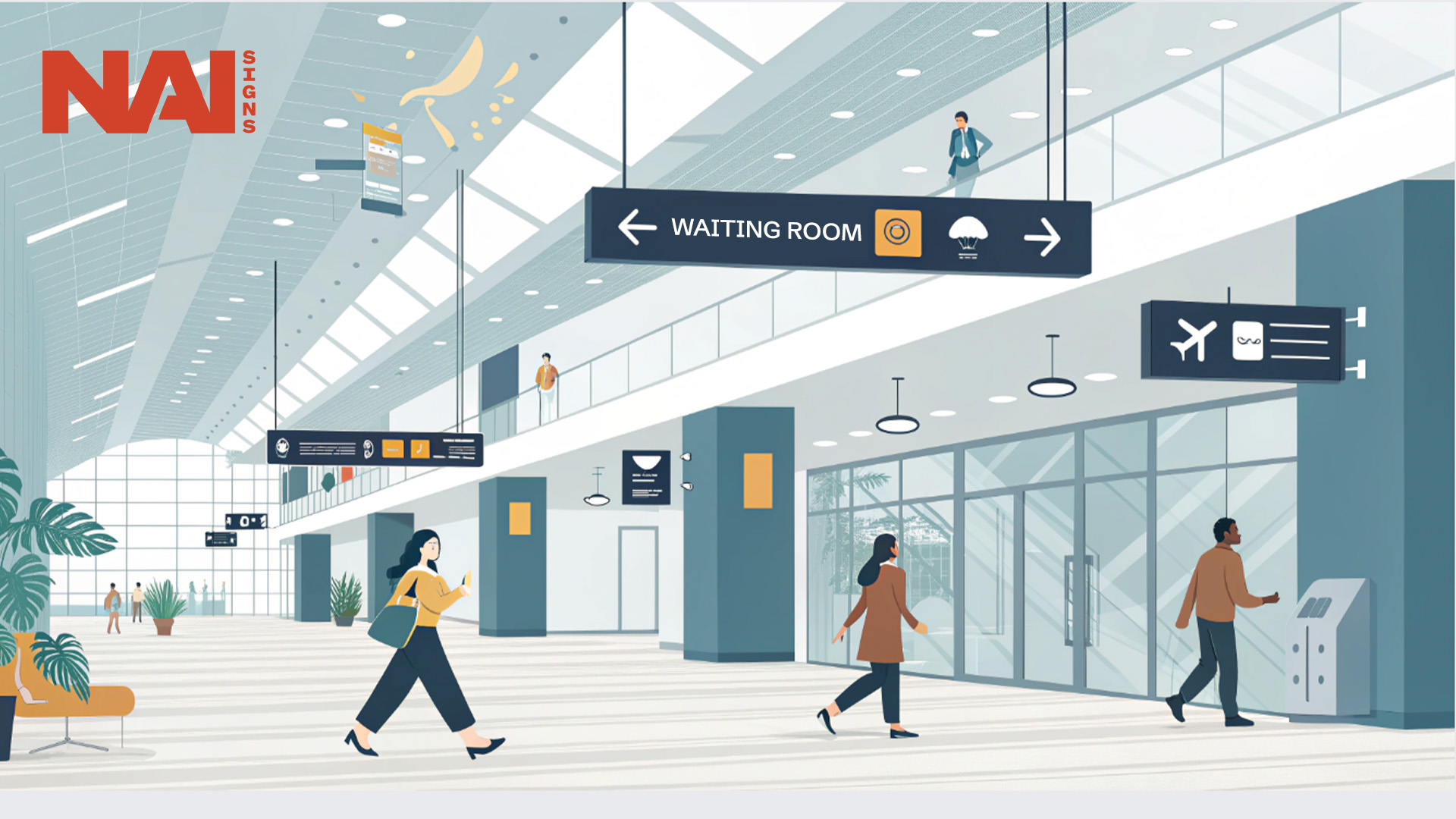
When a building wants to be truly effective, it doesn’t need to scream out for attention; instead, it should guide its visitors with a quiet and intuitive approach. With well-known architectural wayfinding, the best buildings know that they can anticipate and answer a visitor’s needs before they even ask; that’s the magic of it all. Walking into a new building shouldn’t be a stressful experience, nor should it be like a wild goose chase. Wayfinding signage is an art that has signs as just one part of its equation. It’s basically about buildings that listen to, and designs that speak, in a beautiful fusion of form and function, where getting around is as natural as breathing.
At NAI Signs, we think that wayfinding signs aren’t just about arrows and directory signs; it’s about feeling people’s needs and how they move, pause, and respond to spaces. In this blog, you’ll learn how architectural wayfinding turns spaces into intuitive experiences and how NAI Signs designs systems that guide, connect, and inspire.
What Is Architectural Wayfinding and Why Does It Matter
Architectural wayfinding is one of the key principles that is always in the background when designing buildings. Coming from the idea that buildings should “think for you”, wayfinding signage is essentially the orchestration of how we get from one place to another, blending architecture, psychology, and communication.
Places like hospitals, university campuses, airports, and malls can be considered as huge ecosystems, but a well-designed wayfinding system can tame their complexity and make them feel welcoming and user-friendly, even for someone who has never been there before.
The consequence of good wayfinding is that it turns confusion into tranquility, hesitation into fluidity, and creates kind spaces that make you feel at home.
The Psychology of Direction: Why People Remember Flow
When entering a building, you’ll often get a good idea of its layout. Even if you’ve never been there before, this is basically because of architectural wayfinding. Coming into a brand-new place can be a real challenge, but clear and well-thought-out signage can calm those nerves.
Architects know that light, color, repetition, and curves are things that we can easily remember, which is why they use soft, soothing language, calming cues, and an assortment of visual elements.
Think about calming music and subtle sounds to take the edge off and give us a sense of where we are in a building. It’s what turns a hospital or a museum into something that’s easy to navigate and doesn’t feel like a maze.
NAI Signs, being known as the masters of wayfinding signage, tap into the psychology of people, making sure that any space is turned into functional territory and turning foggy ideas into clear-cut reality.
Blending Form and Function: Where Design Becomes Direction
When it comes to architectural wayfinding, signs aren’t just pasted on the wall; they are an integral part of the building’s design. Coming in the form of etched glass in corporate lobbies, suspended aluminum in airports, and curved steel that follows the flow of a hallway.
When done perfectly, signs nearly disappear and become part of a building’s identity; you don’t even notice them, you follow them. At NAI Signs, we treat wayfinding systems as we would like a sculpture, analyzing light, texture, and motion, and the final result is a sign that doesn’t disrupt the overall aesthetic, but rather completes it.
Material Choices That Shape the Experience
In architectural wayfinding, textures are essentially the language of a building’s personality, and they can be anything but just decoration. Glass is associated with openness, wood with warmth, and metal with sharp, modern precision. Coming into contact with different materials, you perceive them very differently, too. The cool glide of stainless-steel screams efficiency, while the soft warmth of matte acrylic is inviting and makes us feel welcome.
At NAI Signs, we understand that the mood our signs create is down to both the design and the materials used. As much as it is about how long they last, basically because we pick finishes that get along well with the surroundings, are eco-friendly, strong, and lovely.
Light That Leads: Not Just Illuminates
When thinking about the visual elements that we see in our surroundings, lighting is a lot more than just making things visible; it can be very much about setting up the mood and basically acts as a guide to where we need to go. Well-known architectural spaces and buildings use lighting as a key component of their design, and architectural wayfinding is essentially about merging lighting with sign systems to help people navigate these spaces.
Coming across a sign can be softened by a halo of light, and wall graphics can be made more captivating by soft, atmospheric lighting. Directional lights can be laid out in a way that gives off a sense of breadcrumbs down a corridor, leading the eye and mind to the destination.
Turning drab corridors into exhilarating experiences, lighting adds a rhythm to the journey, and at NAI Signs, we take advantage of this, supplying light that is not only warm, efficient, and environmentally friendly but also gives out a sense of purpose and feels like the path it is illuminating.

Sustainable Wayfinding: Smart Design & Thoughtful Impact
In the year 2025 and onwards, sustainability is a given, no longer a fleeting trend. Architects now use eco-friendly materials, modular components, and energy-efficient lighting.
Here at NAI Signs, we have made sustainability a core element of every single one of our designs, and have turned to recycled substrates, low-VOC finishes, and LED lights that are far more energy-efficient and long-lasting. The message that architectural wayfinding sends is not just about navigating space; it’s about showing what’s important.
The Future of Architectural Wayfinding
Looking at the future of architectural wayfinding, it’s clear that digital technologies are already playing a major role in the design of our surroundings. Walking through an airport or a shopping mall and struggling to find your way to the next destination won’t be such an issue anymore.
Signs that can adjust their message according to the time of day, or even the movement of crowds, and speak in different languages through intricate light patterns that are starting to become the norm. Interactive booths that can sense what you’re about to do and adjust their response in accordance are being rolled out everywhere.
Well-known in the architectural world, AI and real-time data are turning traditional wayfinding into living, breathing systems. These systems can not only direct people but can also look out for them, adapting to their needs.
As the future unfolds, NAI Signs will be at the forefront of this evolution and pioneering spaces that have a mind of their own. Combining innovative design, AI, and emotional intelligence, we’re working to develop public spaces that don’t just speak to people but think for them.
Final Thoughts
We’re not just telling people where to go; we’re giving them a sense of knowing they’re already on the right path when creating wayfinding systems. Architectural wayfinding is omnipresent, in airports, offices, public spaces, and private campuses; it’s the unseen connection that gives people their purpose. When signs, light, and building structures come together in a perfect symphony, the result is not just clear directions but also the establishment of trust. At NAI Signs, we craft wayfinding systems that consider the world of tomorrow and its needs, beautiful, strong, and with a human edge. Our wayfinding systems don’t just speak to users.